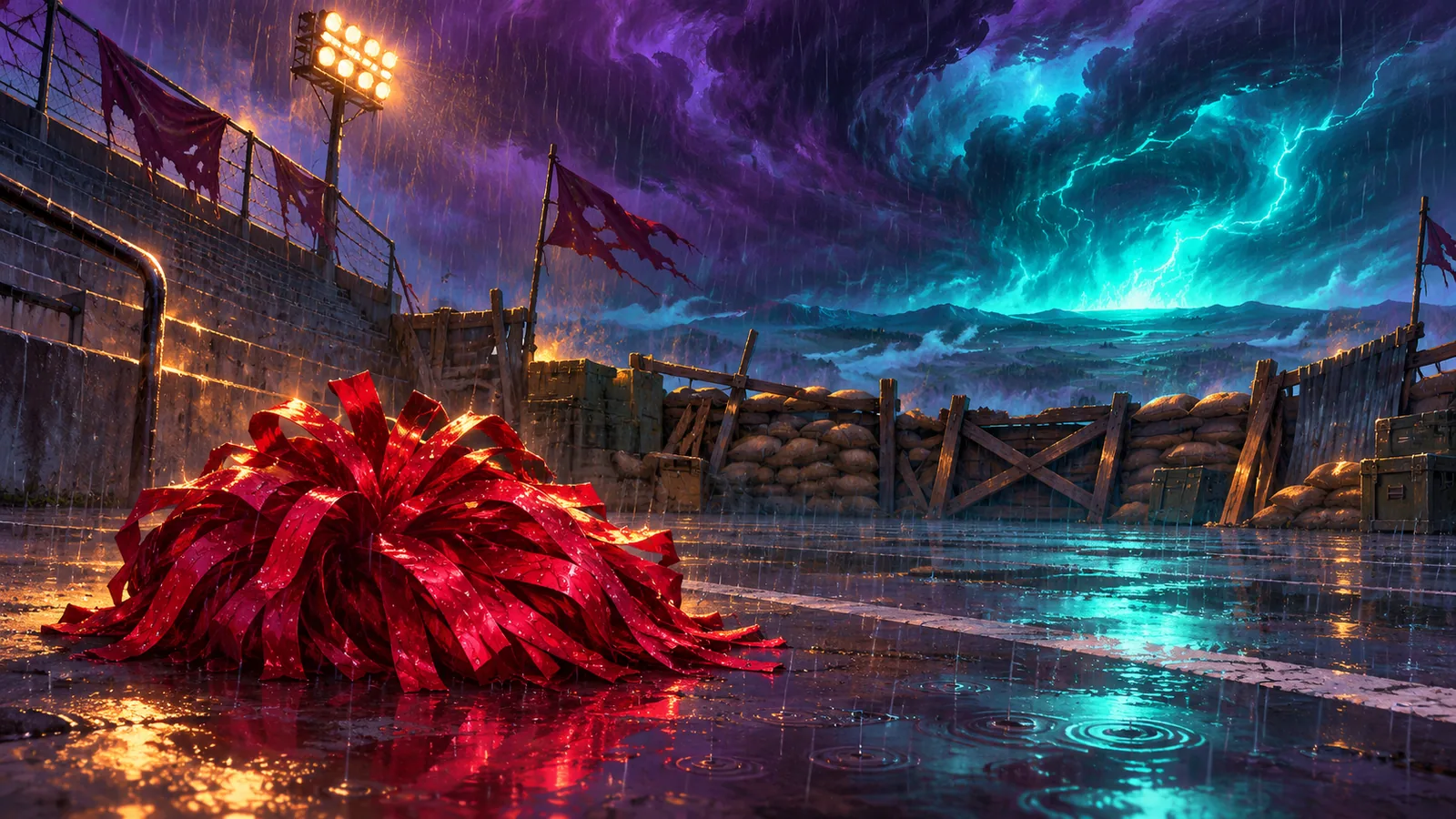
One television series told me to save the cheerleader. A game wanted me to save the world. I thought those two ideas ought to meet.
I loved Heroes.
Ordinary people discovered extraordinary abilities, frequently with very little understanding of how they worked or what they might do to the people around them.
Some tried to help.
Others made appalling decisions.
Occasionally, helping and making appalling decisions appeared to be the same activity.
And the series gave us a line that I never quite forgot:
Save the cheerleader, save the world.
I also enjoyed Fortnite: Save the World.
That was a very different experience. There were Husks, structures to defend, resources to collect and a seemingly endless collection of systems to investigate.
But I kept coming back to the combination.
Save the cheerleader.
Save the world.
Eventually, I found somewhere to put it.
The cheerleader
In Heroes, saving one particular cheerleader became important to a much larger mystery.
The series made an apparently ordinary person central to events that could affect everyone.
I enjoyed the uncertainty surrounding that instruction.
It sounded simple.
Finding out what it actually meant took considerably longer.
When Max Aura Dungeon began developing beyond the original game project, I returned to that memory.
The first novel eventually became Save the Cheerleader.
And Rae was the cheerleader.
That gave me plenty to work with. Cheerleaders carry a whole collection of associations: performance, appearance, enthusiasm, athleticism and the unfortunate tendency of fictional stories to use them as decoration in somebody else’s adventure.
Rae has little patience for the last part.
She has her own interests, memories, fears and opinions, some of which are expressed at a volume that Dungeon Dude would probably prefer to avoid.
Especially when she disagrees with him.
Which happens.
The other half
Fortnite: Save the World had already given me hours of entertainment.
I enjoyed gathering resources, constructing defences and finding combinations that worked against the next collection of enemies.
The world could be ridiculous without becoming harmless.
A bizarre-looking monster was still perfectly capable of causing serious trouble.
I also enjoyed how much could be done by experimenting with equipment, classes and abilities.
The Outlander’s deployable robotic bear, T.E.D.D.Y., stayed with me too. Max Aura Dungeon’s B.E.A.R. is a deliberate nod to it.
I didn’t sit down to recreate Fortnite inside a novel.
The game had already given me plenty of memories and ideas to draw upon.
Some of those became little references. Others contributed to the mixture of systems, strange creatures and spectacularly unreasonable situations that I enjoyed developing.
A world filled with Husks had certainly prepared me to appreciate monsters that were more peculiar than dignified.
Rae begins writing
The second Max Aura Dungeon novel, Diaries of a Murderer, gives Rae her own perspective.
She writes about the things happening around her while trying to make sense of memories that don’t always cooperate.
She has to deal with danger, unexpected abilities and other people who appear to be working with only slightly more information than she possesses.
Dude is not always a reassuring source of answers.
Her diary provides opportunities to see how differently two people can interpret the same encounter.
Sometimes she is confident.
Sometimes frightened.
Sometimes furious.
And occasionally she becomes extremely certain that something is a good idea shortly before the universe provides a rather convincing demonstration that it wasn’t.
The red buttons come to mind.
Dude has strong opinions about pressing unfamiliar buttons in dangerous facilities.
Rae has, on occasion, treated his caution as an obstacle that could be overcome.
Their differences are entertaining.
Not always for them.
A rescue is rarely the end of the argument
One of the odd things about the phrase Save the cheerleader, save the world is how neatly it presents the problem.
Find the person.
Save her.
The rest presumably works itself out.
The dungeon has very little respect for that kind of simplicity.
People don’t necessarily understand what they’ve been caught up in. They make decisions based on incomplete information, and the consequences don’t vanish because somebody has completed what appeared to be the objective.
Rae doesn’t become easier to deal with simply because someone has helped her.
She might be grateful.
She might disagree with the plan.
She might have an entirely different idea about what ought to happen next.
I enjoy writing that part of her.
The original phrase gave me an excellent starting point, but it didn’t tell me who Rae would become once she started having her own experiences.
The title
I still remember enjoying Heroes and Fortnite: Save the World.
Those two experiences left behind a combination that seemed wonderfully suited to the kind of universe I wanted to create.
Save the Cheerleader was an irresistible title.
The story has changed enormously through revisions and rewrites. Rae has grown beyond the familiar image that helped inspire her, and the world has become far stranger than the original idea required.
But the connection is still there.
Whenever I think about the title, I remember the television series and the game.
And I imagine Rae discovering that some of her worst experiences began because I thought two references fitted together rather nicely.
I suspect she’d have several things to say about that.
I doubt she’d wait until I’d finished explaining.
Continue reading
Previous: When the World Wouldn't Wait