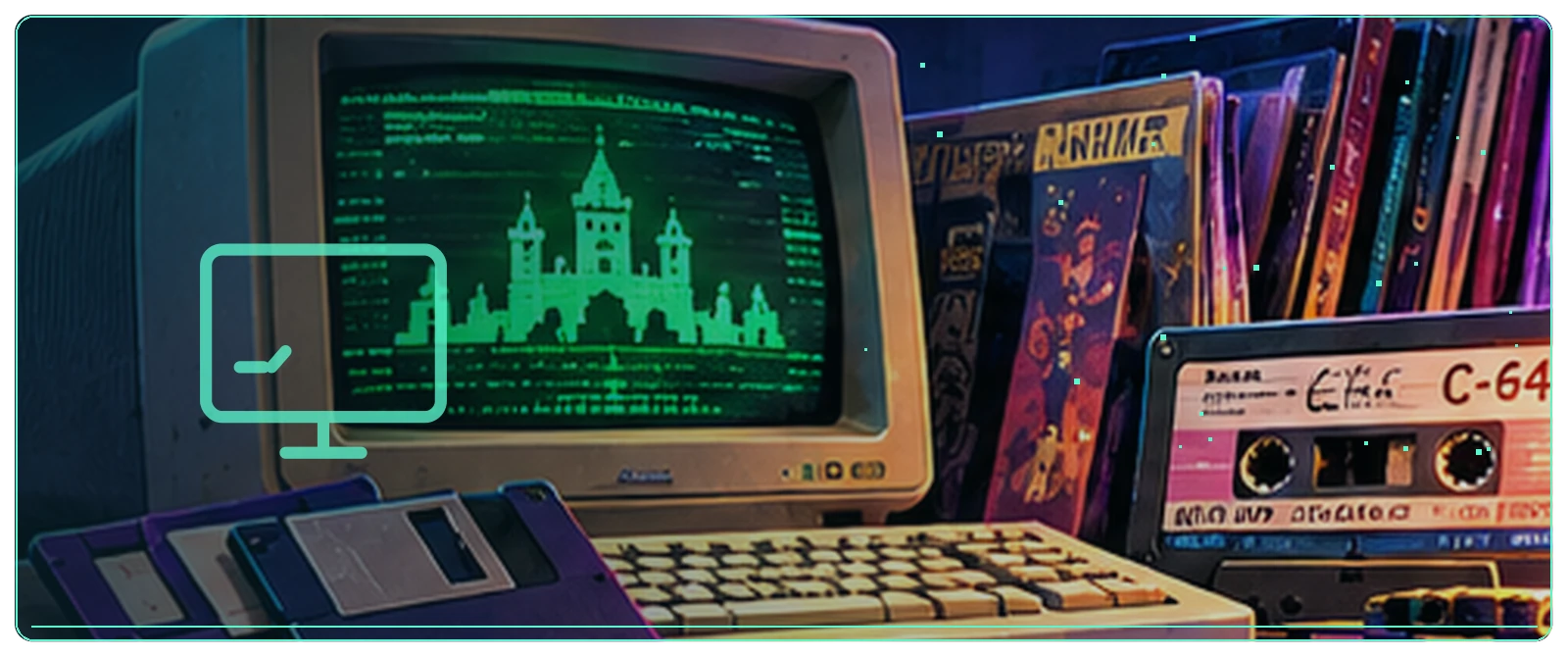
The screen was green, the monitor was enormous, and I was perfectly happy.
The cool kids had Commodore 64s.
I had an Amstrad.
I’m not sure how much of the social hierarchy of home computers was real and how much existed in the minds of children who considered their preferred machine the obvious centre of the technological universe.
But I remember it.
I also remember those enormous monitors.
The actual picture occupied the front. Behind it was a remarkable quantity of equipment, enclosed in a housing deep enough to make the desk feel considerably smaller.
Some screens displayed green text.
Later, colours arrived.
It was exciting.
I would probably be appalled if I had to use one of those old monitors as my main screen today.
Back then, I was delighted to have it.
You told the machine what to do
I spent time programming and learning how computers worked.
There was a particular satisfaction in typing instructions and watching the machine execute them.
Sometimes the result was something useful.
Sometimes I had made a few characters move around a screen or persuaded the computer to perform a calculation.
The sophistication of the result wasn’t always important.
I’d made it happen.
The computer had followed my instructions.
Occasionally, with devastating accuracy.
I could spend ages trying to understand why something behaved incorrectly, only to discover that it had done exactly what I’d told it to do.
The problem was that I’d told it something stupid.
A computer doesn’t have to be malicious to make your afternoon difficult.
Being literal is quite sufficient.
Games before the game library
Games didn’t arrive inside a convenient launcher with cover art, updates, community features and recommendations.
You found the program.
You started it.
With DOS, that often meant typing commands, navigating directories and knowing what you were looking for.
Sometimes the game worked.
Other times getting it running became an activity of its own.
I learned things about computers while trying to play games that had very little interest in teaching me anything.
It was a useful arrangement, although not always a welcome one.
When the game finally started, the graphics might be relatively simple.
A few shapes.
A limited collection of colours.
An environment largely described through text.
My imagination had no difficulty working with that.
I loved fantasy, and the old machines were perfectly capable of introducing me to worlds I wanted to explore.
Even when those worlds had to fit within technical limits that would seem absurdly restrictive today.
The arrival of the mouse
Graphical interfaces changed how I worked with computers.
Windows, icons, menus and mice offered new ways to navigate programs and discover what they could do.
I appreciated being able to point at something instead of remembering a command.
I also continued using command-line tools.
Sometimes typing a precise instruction was faster than navigating several menus to accomplish the same thing.
And when something failed, there could be advantages to knowing what was happening beneath the interface.
I wasn’t particularly loyal to one method.
I liked whichever one helped me get the machine to do what I wanted.
Of course, once I had learned how one interface worked, somebody would release another.
Software developers have always been remarkably inventive about moving familiar functions to unfamiliar places.
I say that as someone who has made software himself.
I have contributed to the problem.
Printing was a public event
Matrix printers made their presence known.
You could hear the mechanism working its way across the paper, producing text and images through a series of impacts.
The printer sounded busy.
Important.
Determined.
Whether the material coming out of it deserved that level of ceremony was another matter.
I remember the pleasure of seeing something I’d created become a physical page.
I also remember the frustration of discovering that the formatting was wrong and having to print it again.
Modern printers still have an impressive talent for becoming difficult at inconvenient moments.
At least most of them no longer sound as though they’re constructing a small building.
The desk got smaller
Computers gradually became faster, quieter and considerably less demanding of physical space.
Screens became thinner.
Storage became smaller while holding more.
Tasks that once required patience, planning or several pieces of equipment became ordinary activities.
Now I can carry a powerful computer in my pocket.
I can use software that understands natural-language instructions, talk to people across the world, make music, work on games and develop books with the help of AI.
The younger version of me sitting at that Amstrad would have had a great many questions.
I suspect his first reaction would have been excitement.
His second might have been to start poking around to discover what happened if he changed something.
There are days when I still approach technology in much the same way.
The equipment takes up less room now.
My curiosity hasn’t become noticeably more compact.