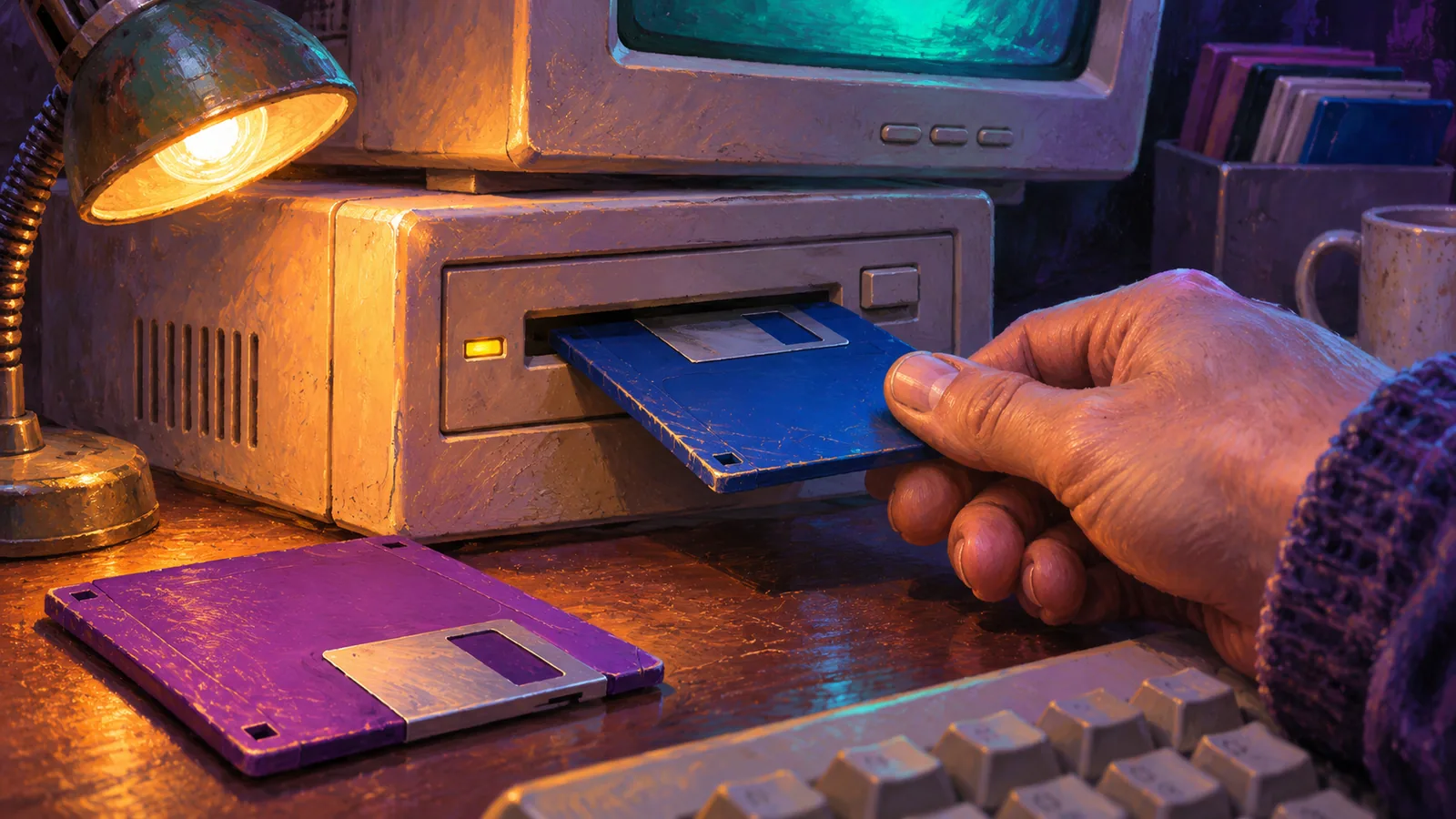
The adventure was going rather well. Then the computer asked for another disk.
I remember the big floppy disks.
Five-and-a-quarter-inch pieces of flexible plastic inside square sleeves, carrying games, programs and whatever else someone had decided to store on them.
Cassette tapes could contain programs and data, too.
Everything depended on the computer being able to read the information.
That wasn’t always a safe assumption.
Sometimes a game loaded without complaint.
Sometimes a disk failed.
And sometimes the computer informed you that it needed another disk, as though the adventure had merely paused while you performed a small administrative task.
Please insert disk two
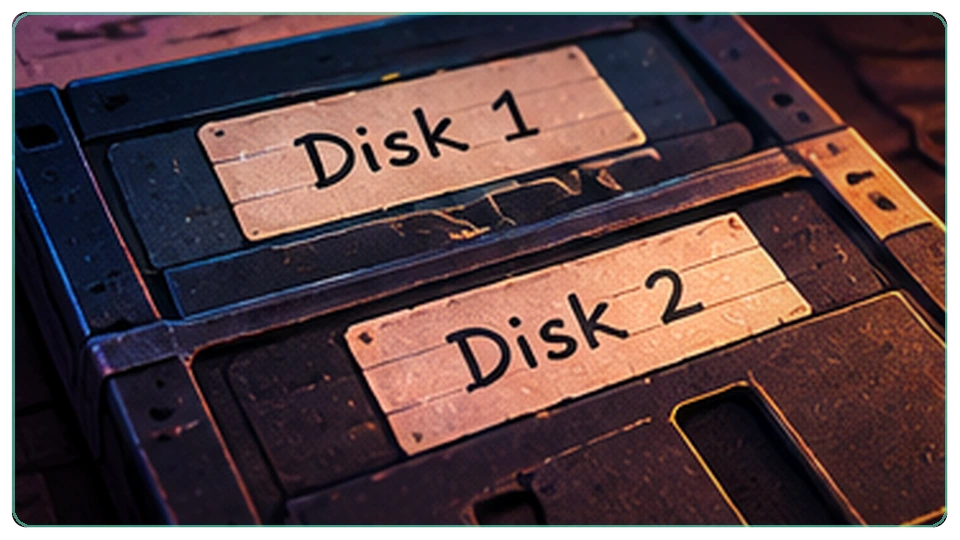
Some games required several disks.
You would be exploring an imaginary world, perhaps getting to something interesting, when the machine demanded another piece of plastic.
So you found the disk and inserted it.
Eventually, you might need to change it again.
A fantasy kingdom could be enormous, filled with characters, monsters and dangerous places.
The computer couldn’t necessarily keep all of it readily available.
So a considerable portion of this imaginary world depended on me having the right disk nearby.
The characters might be fighting for their lives.
I was looking for disk two.
Occasionally, the disk refused to work.
That was a particularly poor way to finish an adventure.
The things I lost
Losing something I’d created was worse.
A game that wouldn’t load was irritating.
Losing work I had spent hours making could be devastating.
Storage media failed. Files became unreadable. Programs behaved badly.
And making a backup required considerably more deliberate effort than people often associate with digital storage today.
Sometimes there wasn’t another copy.
I remember trying to reconstruct work that had disappeared.
You might remember what you wanted to make, but not every little decision that had gone into making it.
A small detail that seemed obvious during the first attempt might be surprisingly difficult to reproduce.
You could rebuild something that looked similar.
It wasn’t necessarily the same thing.
That experience has stayed with me.
I still dislike losing work, although modern tools have made it much easier to preserve copies and recover earlier versions.
I don’t miss the old failures.
The seventh loop
There is a small detail in Save the Cheerleader that has become important to Dungeon Dude.
He has a belt with seven loops.
Six contain plastic bottles.
The seventh is empty.
The arrangement feels significant to him, even when he doesn’t understand why.
As he explores, dies and returns, he begins investigating which things survive and which are lost.
Sometimes a piece of information remains in his memory while the object that originally provided it is gone.
He can’t simply open a save file and recover everything.
He has to examine what exists, compare it with what he remembers and work out which parts of his earlier attempts still matter.
I’ve spent enough time reconstructing lost work to recognize the irritation of knowing you once had something useful but no longer having the thing itself.
Dude’s circumstances are considerably less forgiving.
A failed reconstruction may get him killed again.
What Mew and Hex kept
In Time Does Not Respawn, he returns to discover that Mew and Hex have collected things while he was absent.
Fragments of maps.
Pieces of paper.
Little objects they had noticed him handling.
Food.
They have assembled a terrible approximation of luggage, trying to preserve what they believe he cares about.
I like the image of those two creatures making decisions about what to save.
The collection is hardly an optimized inventory.
But it is recognizably Dude’s collection of peculiar priorities, as interpreted by a cat and a walking hand.
He has lost things.
They have kept some of them.
And their efforts reveal something he hadn’t fully understood about the time that passed while he was gone.
The scene is about much more than saving equipment, but I have a particular affection for the improvised little archive they create.
A map fragment can be worth keeping because somebody spent time understanding what it showed.
A cereal bar can be worth keeping because somebody might be hungry when they return.
Those seem like reasonable priorities.
Even if one of the bars has already been sampled.
The second attempt
When I lost work to a failing disk or another technical problem, I sometimes discovered that recreating it was easier than making it the first time.
I had learned something.
I knew which approaches had failed.
I might even produce a better result.
That wasn’t much comfort when I’d just lost something I wanted to keep.
But it was occasionally useful when I began again.
I’ve encountered the same experience while programming, developing games and writing.
A version can disappear.
A revision can go badly.
Sometimes I deliberately throw something away because I’ve learned enough to recognize that it isn’t worth keeping.
I am considerably happier doing that when I have a backup.
These days, I can store versions of my work without filling a drawer with disks.
I appreciate that more than I probably would have expected as a child.
I still remember holding a floppy disk containing an imaginary world, knowing that something as ordinary as a read error could prevent me from entering it.
Now I have an entire fictional universe living across books, game files and a rather alarming number of revisions.
I make backups.
I’ve learned that lesson.
Continue reading
Previous: When Computers Had Depth
Next: Before the Internet Was Polished