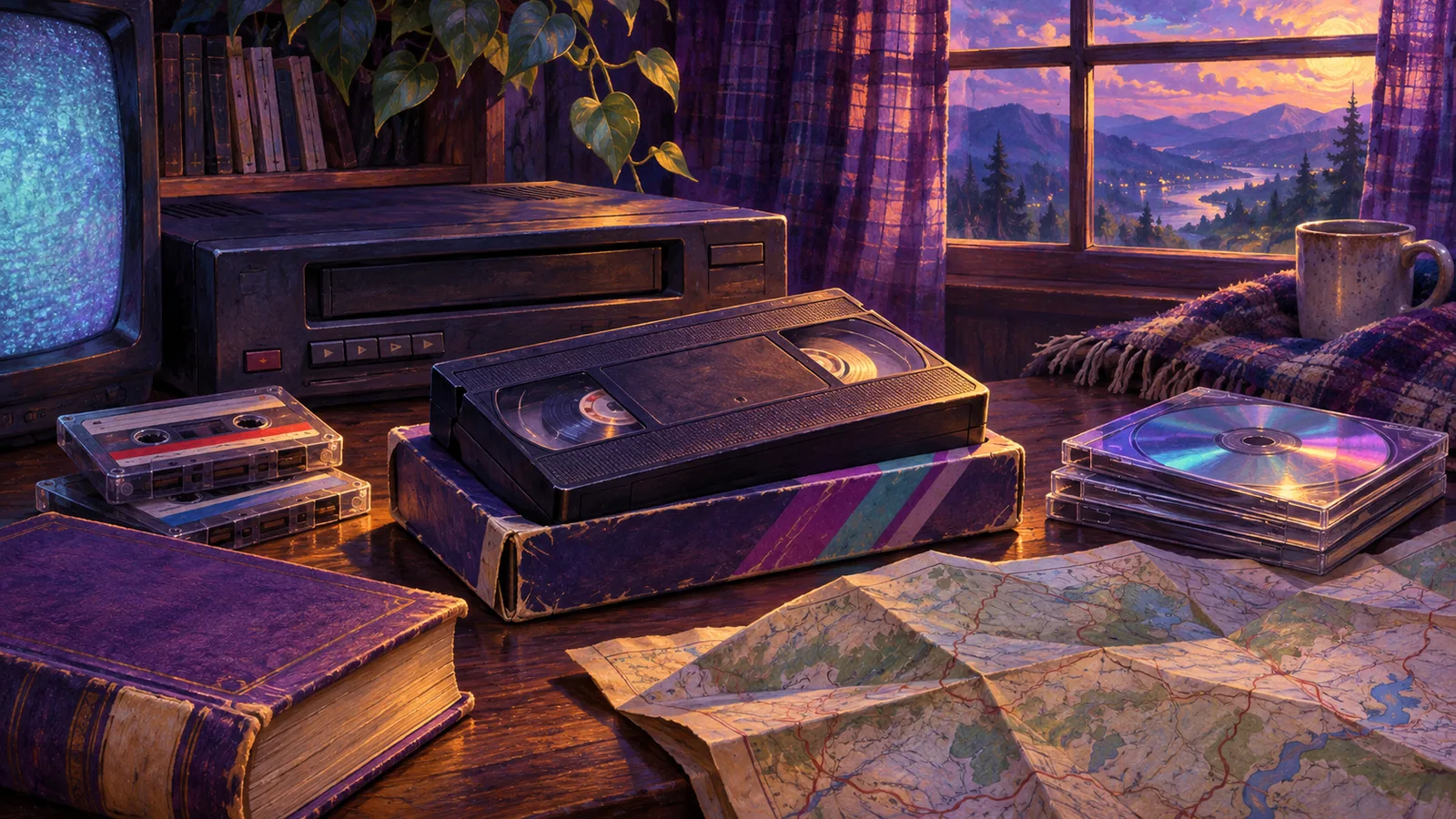
Sometimes you could rent a film. Sometimes you also had to rent the machine needed to watch it.
I remember VHS.
The cassettes, the machines and the occasional need to rent both because having the film didn’t necessarily mean you could play it.
Television was even more particular about how entertainment should be enjoyed.
A programme started at the scheduled time.
If you weren’t there, you missed it.
Perhaps it would be repeated.
Perhaps you would have to find somebody who had recorded it.
The broadcaster had a schedule, and you were expected to organize your evening around it.
Nowadays I can choose from thousands of things to watch whenever I want.
I appreciate that enormously.
Although I sometimes find myself browsing so many options that the evening passes without my watching anything.
Apparently, eliminating the difficulty of finding entertainment creates opportunities for entirely new difficulties.
Music that wasn't in the shop
I’ve always enjoyed electronic music, techno and other styles that weren’t necessarily easy to find where I lived.
Sometimes I had to order music from abroad.
That required discovering that a recording existed in the first place.
Perhaps I’d heard something about an artist or encountered a track somewhere.
Perhaps somebody recommended it.
Then I had to find a way of buying it.
And wait.
There were CDs, cassette tapes and eventually MiniDisc, along with the changing collection of players and recording equipment those formats required.
I enjoyed following the technology.
But what I remember most strongly is how exciting it could be to find a piece of music I’d been trying to obtain.
I might have spent considerable time simply discovering what it was called.
Today I can search an enormous catalogue, hear something immediately and move on to another artist within seconds.
It’s a wonderful change.
I can explore music that would once have been difficult to obtain at all.
But I still remember particular recordings because of the trouble it took to find them.
The librarian knew things
Books presented a different challenge.
Libraries gave me access to far more literature than I could reasonably own.
But finding something interesting could depend on what the library had, what its staff knew and which books somebody happened to recommend.
A knowledgeable librarian could introduce you to an entire collection of authors you’d never encountered.
Someone whose interests were very different from yours might not know what to suggest.
And no recommendation could put a book on the shelf if the library didn’t have access to it.
Today, digital catalogues and recommendation services make enormous collections searchable.
That’s extraordinary.
It’s also made me appreciate how peculiar recommendations can be.
A service may notice that I enjoyed one kind of story and become convinced that I ought to read another hundred books resembling it.
A person can do the same.
But someone who really knows literature may suggest an unfamiliar direction because of a conversation that has very little to do with my previous borrowing history.
I have discovered wonderful things through both people and computers.
I have received appalling recommendations from both, too.
A map big enough to become furniture
Travelling somewhere unfamiliar involved maps.
Actual paper maps.
You might unfold one across a table to study the route before leaving.
In a car, the map could occupy enough space to become a minor passenger in its own right.
Then there was the business of folding it again.
I never understood why the maps seemed so much more cooperative before they had been opened.
Without GPS navigation, a wrong turn could lead to stopping, checking the route and trying to establish exactly where things had gone wrong.
Sometimes the experience helped me remember the journey.
Sometimes I remembered it because I’d wasted an enormous amount of time correcting a mistake.
Modern navigation is one of those technologies I appreciate without much nostalgia for the difficulties it replaced.
I can travel somewhere new without needing to memorize the route.
But I have also arrived at a destination and realized that I have very little idea how the roads around it relate to one another.
The navigation system understood.
I followed instructions.
We had an effective arrangement until I needed to know where something was without asking it again.
Being allowed to discover something
For much of my childhood and youth, finding a film, a recording, a game or an unfamiliar book could involve a surprising amount of effort.
Sometimes that made the eventual discovery more memorable.
Sometimes it merely made life irritating.
I don’t believe entertainment was better because it was harder to obtain.
I’d rather have today’s access.
But those experiences affected how I approached unfamiliar things.
I became accustomed to searching, asking questions, trying different routes and occasionally discovering something entirely different from what I’d set out to find.
I still do that.
The tools have changed.
When I want to hear a piece of music now, I don’t generally need to find an overseas supplier.
When I want to watch a film, I don’t have to check whether I can borrow a video player.
And when I need directions, a small device in my pocket can provide them.
All of that is wonderful.
Yet I still remember unfolding a map, waiting for music to arrive and hearing about a book I hadn’t known existed.
The world felt full of things I hadn’t discovered.
It still does.
I just have fewer excuses for not finding them.
Continue reading
Previous: Before the Internet Was Polished