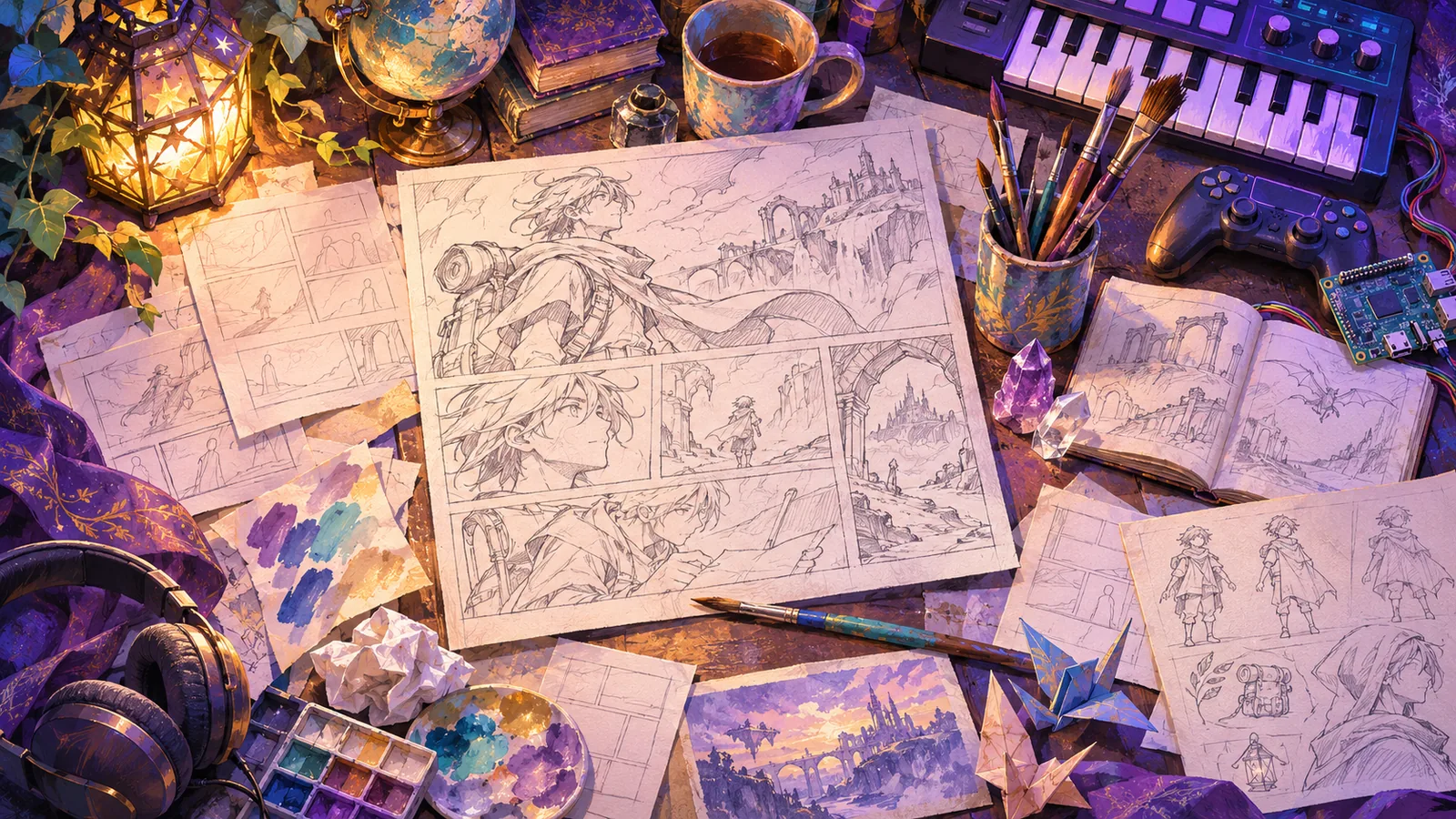
I once tried to make a manga called TAOFEWA. It didn’t become famous, but I still remember wanting to make it.
TAOFEWA began with an idea that was much easier to imagine than to finish.
I wanted to make my own manga.
I’d enjoyed manga and fantasy for years, and the thought of developing a story into something people could actually read and see was enormously appealing.
The project involved working with freelance artists from different parts of the world.
I could collaborate with people whose talents complemented my own, trying to turn a collection of ideas into something that existed outside my imagination.
It was an ambitious undertaking.
It didn’t become particularly successful.
I suspect most people reading this have never heard of TAOFEWA.
That’s understandable.
People I couldn't have worked with before
One of the things that fascinated me about the early internet was the possibility of reaching people far beyond my immediate surroundings.
I had encountered international communities through computers long before TAOFEWA.
Working with freelancers offered another possibility.
I could attempt a creative project with people I might never have met otherwise.
I could bring together different abilities and try to make something that would have been difficult for me to create alone.
Of course, having an idea is a fairly small part of completing a project like that.
You need people to understand what you’re trying to accomplish.
There are decisions to make, things to revise and practical problems that don’t particularly care how exciting the original idea sounded.
I’ve been self-taught in much of my work with computers, and I was accustomed to learning things by trying them.
That approach has served me well in many situations.
It has also brought me into projects where I discovered the difficulties only after I’d become thoroughly enthusiastic about the possibilities.
TAOFEWA belonged to that tradition.
Software nobody was waiting for
I’ve made websites, programs, applications and games.
Some were practical projects.
Others were experiments.
And quite a few were things I wanted to make because I was curious about whether I could.
I’ve had projects that didn’t work as expected.
Others that were completed but attracted very little interest.
Sometimes the difficulty was technical. Sometimes the idea simply wasn’t as good as I’d hoped.
And occasionally, the work involved in finishing something became considerably greater than the excitement that had started it.
There’s a peculiar moment in software development when you’ve worked on an idea for so long that you begin wondering whether anybody actually needs the thing you’re making.
That can be an important question.
It’s also an inconvenient one to encounter after you’ve already spent a substantial amount of effort building it.
I haven’t always been especially good at identifying those problems early.
Which explains some of the projects in my history.
Music for the people who might care
Years later, I was creating YouTube videos about niche mobile games.
I enjoyed playing the games, understanding their mechanics and sharing what I’d discovered.
Then I began making music connected to some of them.
I released songs on Spotify.
The potential audience was rather specialized. Most people probably weren’t waiting for musical tributes to obscure mobile games.
But I had ideas I wanted to try.
Some results pleased me.
Others are things I’d approach differently today.
I can look back at older creative work and hear or see the difference between what I wanted to achieve and what I actually managed to produce.
Sometimes that difference is small.
Sometimes it’s enormous.
I still remember the enjoyment of making things, even when the finished result didn’t become what I’d imagined.
And occasionally, the result was peculiar enough that I have to laugh at the fact that I made it at all.
The project that kept growing
Max Aura Dungeon began as a game project.
Then I began writing novels set in the universe.
The game already contained strange creatures, characters, mechanics and plenty of humour from the internet culture I’d spent years enjoying.
Writing gave me room to explore more of those ideas.
Some characters became much more complicated.
Relationships developed.
The world grew.
And I discovered how much work could go into making AI-assisted writing feel like something I actually wanted to publish.
I’ve rewritten chapters, changed major plot directions and discarded material I no longer believed was working.
There have been hundreds of revisions, including nearly three hundred involving the first book.
A surprising amount of creative work consists of deciding that something you previously spent time creating shouldn’t be there anymore.
It’s even less enjoyable when you can remember how pleased you were with it when you first made it.
But if a scene doesn’t work, the hours already invested in it aren’t going to rescue it.
I’ve made that mistake before.
I’m trying to become better at recognizing it.
A thoroughly untidy history
I could arrange my old projects into a nice story about learning and development.
First the websites.
Then the software.
Then the manga.
Then YouTube, music, games and eventually novels.
It would look like a carefully planned progression.
It wasn’t.
I wanted to make a manga, so I tried.
I wanted to experiment with software, so I made programs and applications.
I enjoyed particular games and wanted to share them.
Later, I became interested in making music.
And eventually, the strange little game universe I’d been working on became something I wanted to write stories about.
Each project made sense to me while I was pursuing it, even if the results didn’t always justify the effort.
There are things I would like to revisit.
Others I’d probably leave alone.
And some I might be slightly embarrassed to encounter again.
The list will almost certainly grow.
TAOFEWA
I still like the idea of creating a manga.
I would have preferred TAOFEWA to become something much more successful.
It didn’t, and I can’t pretend that success was unimportant to me.
Of course I wanted people to enjoy what I’d tried to make.
But when I think about the project now, I don’t see it merely as an unsuccessful attempt at something I eventually accomplished differently.
It was its own ambition.
I wanted to create that particular thing.
I tried.
It went where it went.
And years later, I still remember the name.
TAOFEWA.
Perhaps not the greatest commercial success of my creative life.
But unmistakably one of my ideas.
Continue reading
Previous: The Highlight Reel Wasn't Me
Next: Throwing Rocks from Inside the Glass House