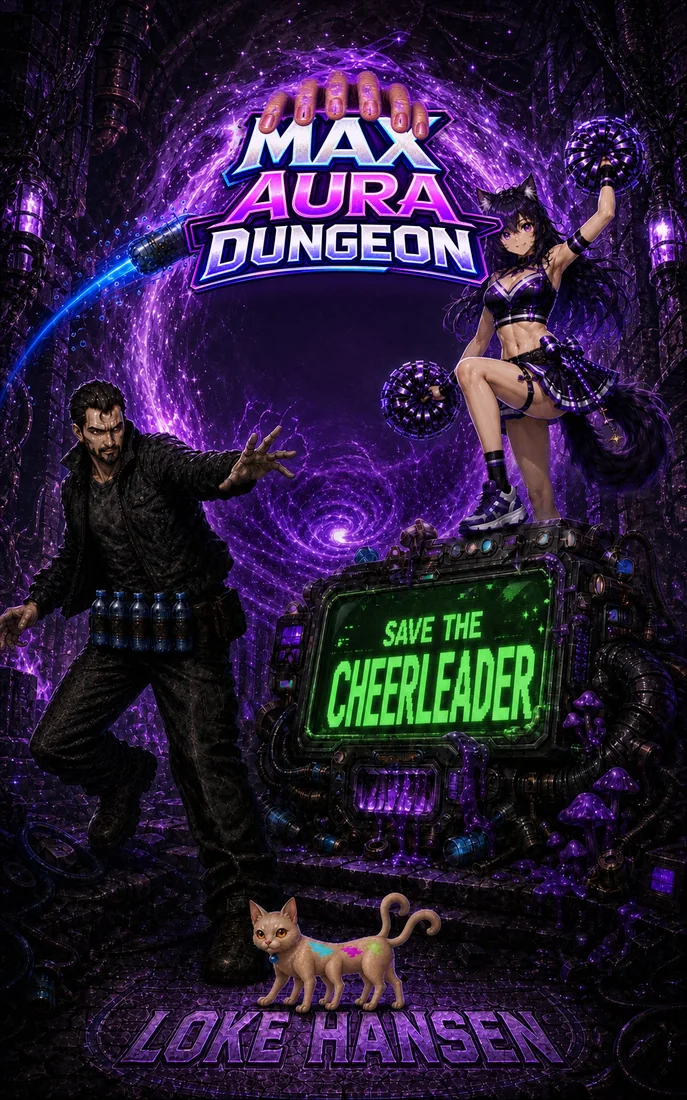
He wakes without a usable name and without enough memory to decide what kind of place he has woken into.
That would be simpler if he knew nothing.
Instead, his hands remember things. His body recognizes motions before his conscious mind can explain them. Smells and objects open brief pieces of ordinary life — a cafeteria, a screen, a meal, the feeling of having once belonged somewhere — then close again before he can recover the names that would make them useful.
Around him, manufactured panels disappear into black stone as though the two materials have always agreed on the arrangement. Something has already happened here. He does not know what.
He does have six battered plastic bottles in a harness with seven loops.
It is not much of an inventory.
It is enough to start testing the world.

Correction added by the person being described
Six bottles. Seven loops. The empty loop was data. Also, “dungeon” was still a working theory.
The first problem in Save the Cheerleader is survival. The second is evidence.
If the world refuses to explain itself, how much can you learn by throwing things at it carefully enough?
A body with better records than the mind
The narrator has lost the kind of memory that would make introductions convenient. His name is gone. So is the larger story that would tell him where he belongs.
Other kinds of memory have survived badly but stubbornly.
A grip feels correct. A route makes sense before he knows why. The smell of browned bread can produce more emotional certainty than a room full of impossible machinery. An old object can return the texture of an ordinary day while withholding the face of the person who shared it.
This makes memory neither absent nor trustworthy. It has become evidence without an index. The cruel part is that some fragments are warm enough to prove that something mattered and incomplete enough to tell him how to get back to it.
Identity begins to take shape around the fragments instead of waiting for the past to return intact. Competence arrives before biography. Preferences survive without context. Embarrassment turns out to be remarkably durable. So do habits of observation, irritation, care and the instinct to move when something else is in danger.
He cannot simply remember who he is.
He can watch what he keeps doing.
Six bottles, a piece of carton, and several theories that did not survive testing
The first useful equipment is not legendary.
Plastic bottles become weapons because they are available and because, unlike much of the environment, their behaviour is familiar enough to measure. Flattened carton becomes a map. Scraps become categories. A workbench becomes an archive because putting strange things in piles is at least one way of making them less strange.
The narrator measures routes, repeats throws and returns to places that have already hurt him because one successful escape proves less than he would like.
A pattern works often enough to become a theory. The next encounter exposes what the theory missed. He keeps the useful part and crosses out the confidence.
The place can be learned.
That is not the same as saying it can be understood.
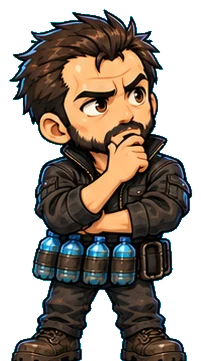
Methodological objection
I had repeatable tests. Several of them failed. That is still data.
Humor and danger share the same machinery here. A failed experiment can be absurd. It can also put teeth very close to something important.
Progress means becoming harder to fool with the same mistake twice.
A group that technically does not exist
He does not stay alone.
A tan cat acquires the name Déjà Mew. A small disembodied hand with six fingers, a blue bead and strong opinions about other people’s property becomes Hex.
Neither arrives with an explanation. Trust is assembled from behaviour instead: staying nearby, coming back, warning, stealing useful things, interfering with terrible ideas and occasionally putting a body in the wrong place because something else would be hurt otherwise.
The narrator prefers practical language for this development.
Routes become safer if everyone gets through them. Food can be shared for operational reasons. Risk calculations change because losing a cat or a hand would complicate future work. These are all perfectly serviceable explanations, provided nobody asks why the explanations keep becoming more elaborate.
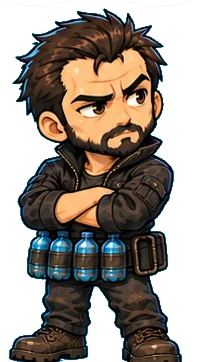
Classification dispute
I said I wasn’t adopting anything. The available evidence was mixed.
The evidence accumulates in what he starts carrying, waiting for and going back to retrieve.
When behaviour starts leaving a mark
At some point, certain actions begin producing effects around him.
“Aura” is not his preferred term. Unfortunately, it keeps fitting.
The interesting part is not simply that the effects are useful. It is that they do not behave like equipment he selected from a menu. Repeating the appearance of confidence is not enough. Trying to look impressive can fail completely. Other moments — control under pressure, protecting something smaller, moving through a route with earned certainty — seem to matter in ways he can observe without yet being able to reduce them to a clean rule.
So he does what he always does.
He tests it.
The result creates an uncomfortable question. If the environment responds to patterns in the way you behave, what exactly is it recognizing? The action? The habit? The reason? Merely the shape of something that looks convincing from the outside?
The effects remain useful. The explanation stays provisional.
The camera keeps a different record
Later, observation becomes harder to treat as background.
Eventually he finds spaces where cameras, displays and automated systems do more than record what happens. Bodies can be reframed. Fear can be edited into a better clip. A stumble can become a joke when replayed from the right angle. A fight can become more valuable simply because it lasts long enough to hold attention.
A living thing experiences danger. A camera records the part that fits inside its frame.
He can test a camera by throwing something at it. Testing what its recording leaves out is harder. The replay may be accurate and still make the wrong moment look important.
Once observation starts changing the conditions around the observed, “audience” is no longer quite the right word.

Narrow factual claim
There are cameras. I am confident about this because I threw things at several of them.
The title knows more than he does
The reader starts the novel with one piece of information the narrator does not have:
Save the Cheerleader.
He does not wake with those words as a quest marker floating in front of him. For much of the book, he has more immediate problems and much less context than the title suggests. The reader can see fragments gathering around performance, screens, purple-and-white imagery and a woman he almost recognizes, while he is still trying to determine which conclusions are real and which are simply his mind being eager for a pattern.
Only much later does the phrase itself become part of his own problem.
By then, “save the cheerleader” has to compete with everything that happened while he was busy not knowing it was the title of his life: maps, broken theories, companions, systems that learn, things that need protecting and responsibilities that refuse to remain hypothetical.
The title points somewhere.
The route toward it changes the person who has to follow.
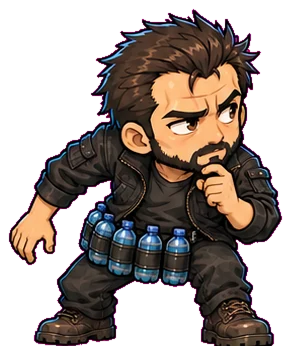
Objection to implied scheduling
For the record, I was dealing with several active problems before the title became actionable.
Somewhere beyond his incomplete maps, the person implied by the title has her own version of events.
The rules can be learned. That is not the comforting part.
Save the Cheerleader is a dungeon story in which learning the rules does not make the world simple.
Its progression grows out of behaviour, experiment and consequences rather than clean menus. Its comedy comes from practical reasoning applied to situations that do not deserve to be practical. Its emotional center develops quietly through the increasing number of things the narrator can no longer treat as somebody else’s problem.
There are monsters and fights. There are abilities. There are maps, failed hypotheses, strange machines and objects that should not matter as much as they do.
But the central pleasure is discovery: watching someone build a workable model of an impossible place while the place keeps producing evidence that the model is incomplete.
He can learn the rules.
Sometimes.
Trusting what they are for is a different problem.